


Lung cancer diagnosis is undergoing a structural transformation driven by artificial intelligence, advanced data science, and the rapid expansion of AI patents in oncology. Cancer has never been a single problem with a single solution. It is a moving target shaped by genetics, environment, lifestyle, and chance. Among all cancers, lung cancer stands apart not only for how common it is, but for how quietly it advances. Lung cancer is the most frequently diagnosed cancer and the leading cause of cancer-related deaths globally, accounting for nearly 2.5 million cases (1 in 8 cancer diagnoses) and 1.8 million deaths (1 in 5 cancer fatalities) every year.
What makes lung cancer especially lethal is not simply its biology, but its timing. Lung cancer is not uniquely aggressive in all cases. It is uniquely late-detected. By the time lung cancer is diagnosed through symptoms, the disease is often already advanced, dramatically reducing survival probabilities and treatment options.
This is where the story begins to change.
Early lung cancer diagnosis transforms outcomes. Catch lung cancer when it is still localized, and the difference between life and death can be dramatic. For decades, medicine struggled with this timing problem. Human vision misses subtle patterns. Human judgment varies. Clinical data volumes overwhelm even experienced specialists. Artificial intelligence now steps into this gap, not as a replacement for clinicians, but as a force multiplier reshaping how early lung cancer can be detected and how precisely it can be managed.
Why AI Is Transforming Lung Cancer Diagnosis
Modern lung cancer diagnosis generates massive datasets. A single chest CT scan can contain hundreds of image slices per patient. Add pathology slides, electronic health records, molecular biomarkers, and genomic data, and the complexity exceeds what manual interpretation can consistently handle.
Artificial intelligence thrives in precisely this environment.
Machine learning models are trained on thousands of annotated cases, enabling detection of subtle malignancy-associated patterns that often appear before symptoms, before radiologists flag abnormalities, and sometimes even before a tumour becomes visible on conventional imaging. This represents not incremental improvement, but a shift in diagnostic timing.
A striking example is the AI system Sybil, which demonstrated the ability to correctly identify 86% of lung cancer cases and 94% of healthy lungs within one year of screening. The implication is profound. A one-year lead time in lung cancer diagnosis can mean the difference between curative surgery and palliative care.
In histopathology, AI algorithms have reached up to 97% accuracy in classifying lung cancer subtypes from tissue samples. This level of precision directly informs clinical decision-making, because treatment selection increasingly depends on tumour subtype, molecular behaviour, and individual patient biology rather than broad categories alone.
Imaging is only one layer. AI-driven pathology tools analyze tissue samples. Genomic AI systems examine circulating tumour DNA (cfDNA) fragments in blood, powering the emerging lung cancer diagnosis blood test paradigm. Each capability on its own is powerful. Combined, they redefine what early detection means.
From Detection to Personalization in Lung Cancer Diagnosis
Diagnosis is no longer the finish line. It is the starting point for personalization.
Every lung cancer case is biologically unique. AI excels in this complexity. By integrating clinical history, imaging data, molecular biomarkers, and treatment outcomes, AI systems can predict how an individual patient is likely to respond to specific therapies. This shifts care from standardized protocols toward precision strategies.
For patients, this means fewer unnecessary side effects and better outcomes. For healthcare systems, it means smarter allocation of resources. For innovators, it creates layered intellectual property opportunities. Algorithms, data pipelines, training methodologies, sample preparation techniques, and clinical workflow integration all become strategically patentable when structured correctly.
This convergence of diagnostics and therapy also explains why AI patents in oncology 2021 and beyond have accelerated sharply. The innovation is no longer only about what the model predicts, but how it learns, adapts, validates, and integrates into real-world clinical environments.
A Market Accelerating Faster Than Medicine Alone
The commercial momentum behind AI-driven lung cancer diagnosis is unmistakable. The global AI in cancer diagnostics market crossed USD 137 million in 2022, with lung cancer tools representing a significant growth segment. North America currently dominates adoption and commercialization, while Asia has emerged as an aggressive innovation and patent filing hub.
The global lung cancer diagnostics market is projected to grow at a CAGR of 6.1%, indicating sustained demand rather than short-term hype. This growth reflects confidence that AI-powered lung cancer diagnosis is becoming healthcare infrastructure, not experimental technology.
Behind this momentum lies an expanding intellectual property ecosystem.
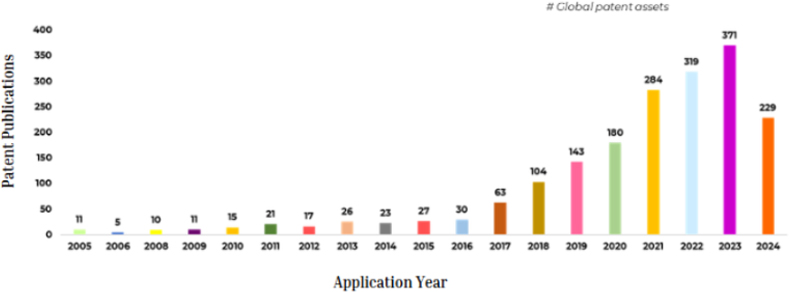
Nearly 2,000 active INPADOC patent families now cover AI-based lung cancer diagnosis technologies. More than 87% of these filings appeared after 2016, signaling a sharp inflection point when AI transitioned from academic research into commercial priority. Filing activity peaked in 2023, reflecting both technological maturity and competitive urgency.
China, the United States, and India together account for over 70% of global filings, demonstrating where governments, institutions, and companies see strategic long-term value.
Who Is Shaping the IP Landscape in AI-Based Lung Cancer Diagnosis
Innovation in AI-based lung cancer diagnosis is concentrated among a small group of strategic players, each pursuing distinct technical approaches.
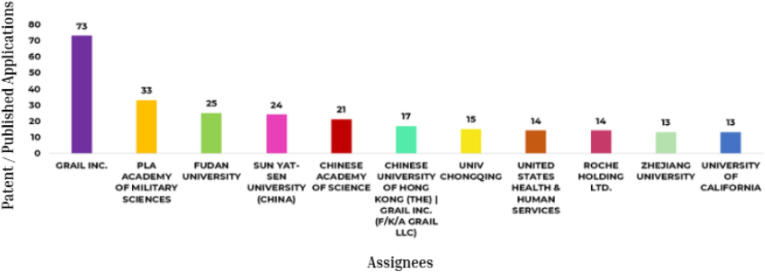
Leaders by Portfolio Size:
The largest portfolios belong to:
Together, they represent a significant share of all filings in this domain.
GRAIL Inc.: Biology-First AI at Population Scale
GRAIL Inc.’s portfolio reflects a biology-first AI strategy. Its patents combine machine learning techniques (support vector machines, random forests, convolutional neural networks, autoencoders, and ensemble methods) with cell-free DNA (cfDNA) as the diagnostic input.
This approach moves lung cancer diagnosis away from dependence on imaging infrastructure toward scalable, minimally invasive blood-based screening. From an IP perspective, this is powerful. cfDNA-based AI systems can operate at population scale and integrate easily into national screening programs.
PLA Academy of Military Sciences: Imaging-Centric Risk Intelligence
The PLA Academy of Military Sciences has filed 32 patents in China alone, making it the most active assignee in that jurisdiction. Its inventions focus on AI-based analysis of chest CT scans to assess malignancy risk of sub-solid nodules.
What distinguishes these filings is the multimodal architecture: imaging data is combined with biological markers and clinical parameters to improve accuracy and reduce false positives. From a patent perspective, these inventions protect not only models but also integrated clinical decision frameworks.
Fudan University and Sun Yat-sen University: Academic Depth with Clinical Intent
Fudan University’s 24 patent assets reflect strong academic leadership. Sun Yat-sen University has demonstrated consistent filing activity between 2021 and 2023, with 12 filings in 2023 alone.
Patent CN118553407A illustrates the direction of innovation: a multimodal deep learning system integrating pathological data, transcription data, and clinical prognosis to improve lung tumour diagnosis, predict tumour characteristics, and estimate survival time in real time. The system is designed to integrate directly into hospital workflows.
Other Active Commercial Players in AI-Based Lung Cancer Diagnosis
Several additional organizations are building strategically meaningful positions:
Optellum’s innovation highlights that training methodology, dataset structuring, and probability calibration are defensible technical contributions in AI-based lung cancer diagnosis.
Notably, despite the intensity of patent activity, the space has seen little litigation so far. That calm is unlikely to persist as commercial products mature.
Expanding the Ecosystem: Insilico Medicine, Certis Oncology, and Market Signals
Beyond diagnostics specialists, companies such as Insilico Medicine illustrate how AI-driven biomedical platforms increasingly span drug discovery, biomarker identification, and disease stratification. While Insilico Medicine is best known for therapeutic innovation, its multimodal data platforms align directly with the computational foundations underlying advanced lung cancer diagnosis systems.
Certis Oncology represents a clinically grounded precision oncology model that emphasizes personalized treatment strategies guided by advanced analytics and molecular profiling. Although Certis Oncology is not positioned as a pure AI vendor, its data-driven model reflects the same structural shift transforming lung cancer diagnosis.
Healthcare platforms branded around advanced analytics such as Certis AI further demonstrate how clinical organizations increasingly position machine intelligence as core infrastructure rather than experimental add-ons.
Investor sentiment also reflects this shift. Market interest in companies like Intelligencia AI highlights how financial markets increasingly value predictive analytics in healthcare. The performance of Intelligencia AI stock has become one proxy indicator for broader confidence in AI’s impact on clinical outcomes and biomedical innovation.
How Lung Cancer Is Diagnosed in Clinical Practice
Despite technological advances, clinical workflows remain grounded in structured diagnostic frameworks.
Imaging and Initial Evaluation
Patients often enter the diagnostic pathway through symptoms or cancer screening programs. Traditional tools include:
Modern AI-enhanced tools increasingly support both screening and diagnostic interpretation.
Staging and Classification
Once cancer is diagnosed, clinicians assign cancer staging based on tumour size, lymph node involvement, and metastasis. Lung cancer staging is typically categorized into Stage I through Stage IV. The assigned lung cancer diagnosis stage plays a central role in determining treatment strategy and prognosis.
Age, Coding, and Clinical Documentation
The typical lung cancer diagnosis age skews older, but rising cases among younger non-smokers highlight the need for smarter screening approaches. Clinical systems also rely on standardized documentation using lung cancer diagnosis code frameworks (such as ICD coding) for treatment planning, insurance reimbursement, and population tracking.
Symptoms and Public Awareness
Symptoms remain one of the most common pathways to diagnosis. Educational resources often highlight the 4 symptoms of lung cancer that you should be aware of:
However, symptoms frequently emerge late. Even stage 1 lung cancer symptoms may be mild or absent, which explains why screening and AI-enhanced early detection are so critical.
How Is Lung Cancer Treated After Diagnosis?
Patients often ask: how is lung cancer treated after diagnosis?
Treatment depends heavily on stage, subtype, and molecular characteristics, and may include:
AI increasingly supports these decisions by predicting which patients are most likely to benefit from specific therapies based on integrated data analysis.
Why AI Patents in Oncology Are Strategic Assets
AI-based lung cancer diagnosis sits at the intersection of software, biology, and clinical medicine. That intersection is where patent strategy becomes critical.
Strong portfolios often protect:
Filing early captures foundational innovations. Continuous filing protects iterative improvement. This explains why the explosion of AI patents in oncology 2021–2023 reflects not just innovation volume but strategic urgency.
Looking Ahead: The Future of Lung Cancer Diagnosis
AI is not simply accelerating lung cancer diagnosis. It is changing what diagnosis means.
In the near future:
For patients, this means more cases of lung cancer being diagnosed earlier.
For healthcare systems, it means precision at scale.
For companies, it means fierce competition to own the foundational technologies protected by AI patents in oncology.
Final Perspective
AI-based lung cancer diagnosis has moved from promise to infrastructure. The technology, the market, and the patent ecosystem are aligning around one reality: early detection, smarter decision-making, and precision at scale will define the next era of oncology.
For patients, this means earlier lung cancer diagnosed and better survival.
For clinicians, it means augmented intelligence and reduced uncertainty.
For innovators, it means that IP strategy will determine leadership.
In the future of cancer care, patents are not paperwork. They are positioning.

Download Report
Download Report